

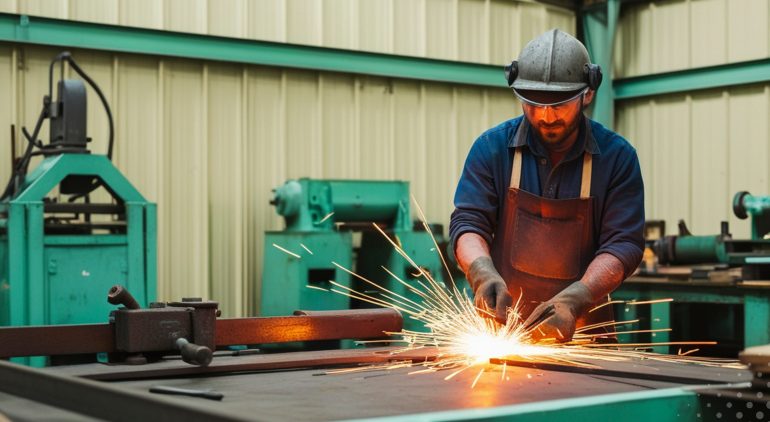
7 Key Steps in the Design & Engineering Process for Metal Products
When you look at a finished metal product — a machine part, railing system, bracket, enclosure, or structural component — it’s easy to forget how much planning goes into it. Behind every precise bend, cut, weld, or finish is a carefully thought-out process. That’s why Design & engineering of metal products is such a critical foundation for quality, performance, and long-term durability.
Whether you’re developing a new product, improving an existing one, or looking for a reliable fabrication partner, understanding the key stages of the engineering journey helps you make smarter decisions. So, let’s break down the 7 key steps in the Design & Engineering of metal products, and how they turn an idea into a reliable, real-world result.
Step 1: Idea & Concept Development — Where It All Begins
Every project starts with a need — and that need turns into an idea. During the first phase of Design & engineering of metal products, the goal is to clearly define what the product must do.
This stage usually includes:
- Understanding performance requirements
- Identifying environment and usage conditions
- Discussing load-bearing expectations
- Reviewing regulatory or safety needs
- Setting project budgets and timelines
It’s a collaborative conversation where engineers and clients work together to explore possibilities — and sometimes uncover challenges early, before they become costly.
Step 2: Detailed Requirements & Feasibility Review
Once the initial idea is clear, the next step in Design & engineering of metal products is to assess whether the concept is practical and efficient to manufacture. At this stage, engineers review material choices, fabrication processes, tolerances, and cost-effectiveness.
Key questions include:
- Is the design structurally sound?
- Will the materials perform well in real-world conditions?
- Can it be fabricated efficiently and consistently?
- Are there ways to simplify the design without sacrificing quality?
This is where smart engineering turns a rough idea into a viable, buildable solution.
Step 3: 3D Modelling & Engineering Drawings
Modern Design & engineering of metal products relies heavily on digital tools. Engineers create detailed CAD models and technical drawings that show every dimension, angle, and connection point.
These drawings:
- Provide precise measurements
- Define tolerances
- Clarify assembly details
- Reduce ambiguity for fabricators
This step is essential for accuracy — especially if multiple parts must fit together seamlessly.
Step 4: Material Selection & Testing
Not all metals are created equally. Stainless steel behaves differently from aluminum. Carbon steel offers different strength and corrosion resistance than alloys. During Design & engineering of metal products, engineers evaluate material choices based on:
- Strength-to-weight ratio
- Corrosion resistance
- Weldability
- Appearance
- Cost
- Environmental exposure
Selecting the right material early prevents premature wear, structural failure, or unnecessary costs later.
Step 5: Prototyping — Turning Design into Reality
Before full-scale production begins, many projects move into a prototype phase. This is a hands-on checkpoint in the Design & engineering of metal products process where engineers and fabricators build a first-run version for testing and validation.
Prototyping helps identify:
- Fit and alignment issues
- Functional limitations
- Design improvements
- Real-world performance observations
It’s easier — and far more cost-effective — to refine a design at this stage than hundreds of parts in production.
Step 6: Testing, Validation & Quality Control
Once a prototype (or small batch) is created, performance testing follows. This ensures the product meets all structural, functional, and safety expectations. During this phase of Design & engineering of metal products, teams may test:
- Load capacity
- Durability and stress resistance
- Environmental exposure
- Dimensional accuracy
- Safety compliance
The result? A final design that you can trust in real-world conditions.
Step 7: Production Planning & Manufacturing Handoff
The final step in the Design & engineering of metal products journey is preparing for full-scale fabrication. Engineers document final specifications, production workflows, tolerances, material handling steps, and inspection requirements. This ensures manufacturing runs smoothly — with consistent quality from the first part to the last.
A well-documented handoff is what separates smooth production from costly rework.
Why Professional Design & Engineering of Metal Products Matters
When you partner with a skilled engineering-driven fabrication company like Accutek Industries, you’re not just ordering parts — you’re investing in reliability, safety, and long-term value.
Professional Design & engineering of metal products delivers:
- Fewer errors and material waste
- Better structural performance
- Lower lifetime costs
- Faster production cycles
- Stronger product longevity
It’s about getting things right for the first time.
FAQs About Design & Engineering of Metal Products
1. Do I need a finished design before contacting a fabrication company?
Not at all. Many clients come to us with ideas, sketches, or early concepts. Our Design & engineering of metal products team can help refine your idea into a manufacturable design.
2. What industries benefit from engineered metal products?
Just about every sector — construction, manufacturing, transportation, energy, retail, agriculture, and custom product development — relies on quality metal engineering.
3. Does engineering increase project cost?
Engineering is an investment that prevents redesigns, delays, equipment failures, and product recalls. In most cases, Design & engineering of metal products reduces total project cost over time.
Ready to Bring Your Metal Product Idea to Life?
If you’re looking for a trusted partner for Design & Engineering of Metal Products, the team at Accutek Industries is here to support you from concept through completion. We combine technical expertise, modern fabrication technology, and a commitment to quality in every project we take on.
Contact Accutek Industries today to discuss your project, request a quote, or learn how our Design & Engineering of metal products services can help you build smarter, stronger, and more successful solutions. Let’s create something exceptional together.
Contact us: 604-626-4700
Location: 4848 275 St Unit-204, Langley Twp, BC V4W 0A3
Follow Us:
Facebook: https://www.facebook.com/people/Accutek-Industires-Ltd/61579864413995/
Instagram: https://www.instagram.com/accuteklangley/